


Most American and European homeowners underestimate how much energy their lighting systems really consume. With smart technology, households can slash power usage by up to 93 percent simply by upgrading and automating their lights. Today’s tech-savvy homeowners are turning to advanced systems not only for energy savings but for customizable safety and ambiance at home. Learn how modern automated lighting solutions put you in control while making your house more efficient and secure.
| Point | Details |
|---|---|
| Automated Lighting Enhances Life Quality | Intelligent systems adjust light based on user needs, improving comfort and ambiance. |
| Energy Efficiency is a Key Benefit | Automated controls can significantly reduce electricity usage and costs over time. |
| Safety and Security Features are Crucial | Automated systems deter intrusions while enhancing visibility in high-risk areas. |
| Integration with Smart Home Technology is Essential | Choose systems that easily connect with other devices for maximum functionality and convenience. |
Automated home lighting represents a sophisticated technological approach that goes far beyond simple on/off switches or basic timers. These intelligent systems are designed to manage lighting through complex communication networks, enabling homeowners to create dynamic, responsive environments that adapt to their specific needs and preferences.
Contrary to popular misconceptions, automated lighting is not just about convenience but encompasses advanced features like energy efficiency, enhanced security, and personalized ambiance control. Modern systems can integrate motion sensors, daylight detection, and programmable scenes that adjust illumination based on time of day, occupancy, or even personal mood settings. These networks communicate between various inputs and outputs, transforming traditional lighting from a static utility into an interactive, smart home experience.
Key characteristics of authentic automated lighting systems include:
These systems provide far more nuanced control than traditional lighting solutions, allowing homeowners to create sophisticated, responsive environments that enhance both comfort and efficiency.
Pro tip: Start with a single room or area when implementing automated lighting to understand the technology and gradually expand your smart home infrastructure.
Smart lighting systems have evolved into sophisticated technological solutions that go well beyond traditional illumination methods. Lighting control systems now encompass multiple architectural approaches designed to meet diverse residential and commercial needs, ranging from simple occupancy detection to comprehensive networked environments.
These systems can be broadly categorized into several key types:
Each system type offers unique advantages depending on specific home automation goals. Wireless systems provide easy installation and retrofitting, while networked systems deliver more advanced programming and energy management capabilities. The complexity can range from basic dimming functions to intricate scene management that adjusts lighting based on time, occupancy, and personal preferences.
Here’s a quick comparison of smart lighting system types and their best-fit use cases:
| System Type | Best Application Area | Installation Complexity | Flexibility Benefit |
|---|---|---|---|
| Stand-alone | Small rooms or closets | Very simple | Localized, no central control needed |
| Networked | Entire homes or large offices | Moderate to high | Centralized management, scalable |
| Wireless | Apartments, rentals | Easy | Quick setup, no new wiring |
| Hybrid | Renovations, custom homes | Moderate | Expansion-ready, future-proof |
Pro tip: Assess your specific home layout and technological comfort level before selecting a smart lighting system to ensure seamless integration and optimal performance.
Smart home lighting technologies have revolutionized home automation through sophisticated sensor integration and wireless communication that transform how users interact with their living spaces. These advanced systems go beyond simple illumination, creating intelligent environments that respond dynamically to occupants’ needs and preferences.
The key features of modern smart lighting systems include:
Wireless technologies have been particularly transformative, enabling homeowners to create flexible lighting configurations without complex wiring. Voice control interfaces add another layer of convenience, allowing users to adjust lighting, create scenes, and manage home environments through simple verbal commands. These technologies work together to create responsive, energy-efficient lighting systems that adapt to individual lifestyles and preferences.
Pro tip: Prioritize systems with compatible wireless protocols to ensure smooth integration and future expandability of your smart home lighting infrastructure.
Smart home lighting represents a significant opportunity for homeowners to optimize energy consumption through intelligent management. Advanced lighting control systems can dramatically reduce electricity usage by eliminating unnecessary illumination and adapting to real-time environmental conditions.
Research demonstrates remarkable potential for energy reduction:
The initial investment in smart lighting technology is typically offset by substantial long-term savings. Homeowners can expect reduced electricity costs, lower maintenance expenses, and increased energy efficiency. Modern systems leverage sensors, wireless connectivity, and intelligent programming to create lighting environments that are both economically and environmentally responsible.
Pro tip: Calculate your potential energy savings by comparing your current lighting electricity consumption with projected smart lighting efficiency ratings.
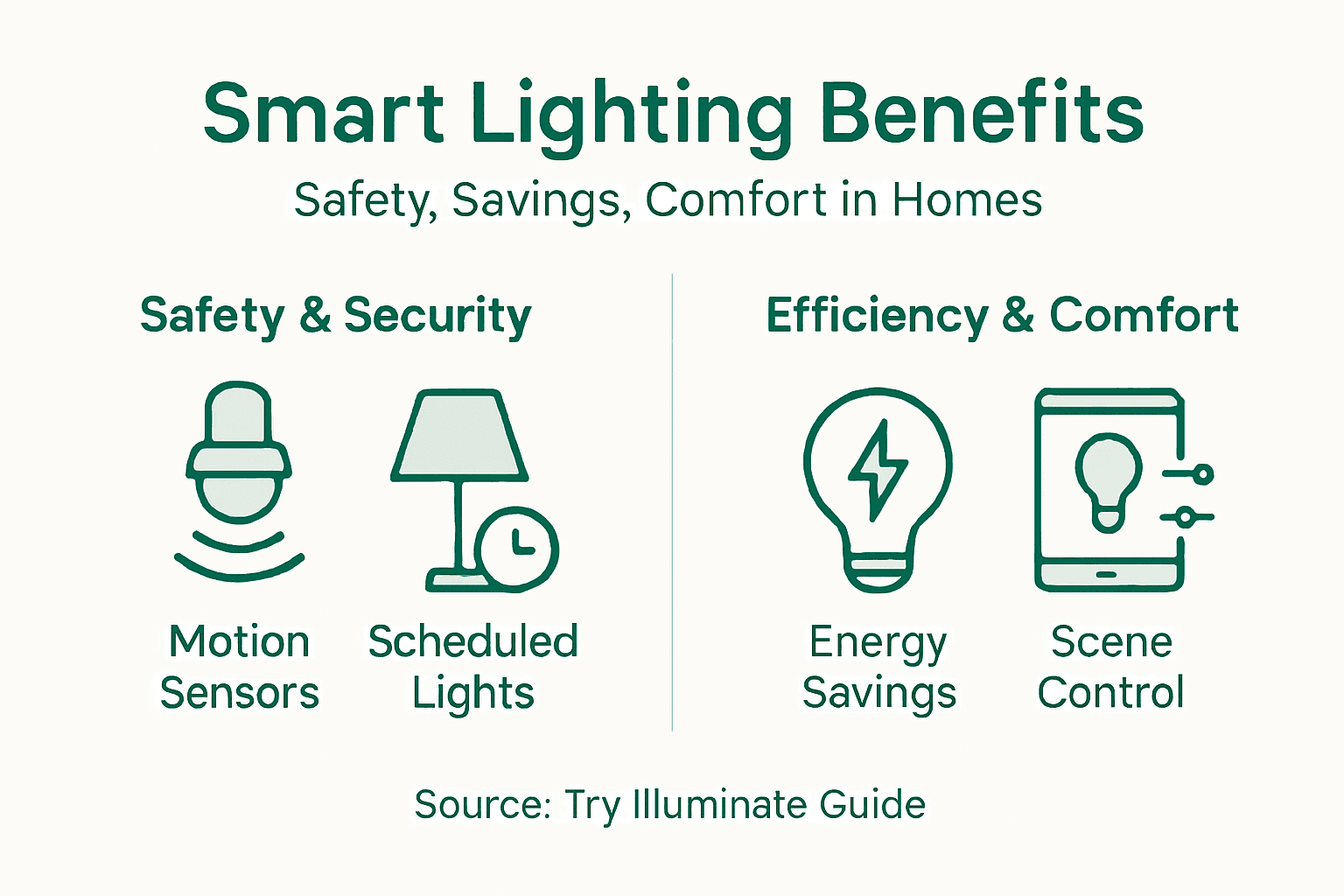
Automated home lighting systems provide far more than simple illumination, offering comprehensive safety and security solutions through intelligent design. These advanced technologies transform home environments by creating adaptive, responsive lighting that enhances personal safety, deters potential intruders, and creates a more comfortable living space.
Key safety and security benefits include:
Beyond physical security, smart lighting systems dramatically improve home ambiance by offering customizable scenes that adapt to different moods, activities, and times of day. Whether creating a relaxing evening atmosphere or setting up bright, energizing morning lighting, these systems provide unprecedented control over home environments. The combination of safety features and mood-enhancing capabilities makes automated lighting a transformative technology for modern homeowners.
Pro tip: Install motion sensors in key areas like hallways and exterior entrances to maximize both safety and energy efficiency.
Automated lighting systems represent a quantum leap forward from traditional manual lighting, fundamentally transforming energy management approaches. Where traditional lighting relies on manual switches and fixed schedules, modern automated systems offer intelligent, adaptive illumination that responds dynamically to environmental conditions and user needs.
Key differences between automated and traditional lighting include:
Control Mechanism:
Energy Efficiency:
Customization:
While automated systems typically require higher initial investment, they deliver substantial long-term benefits through reduced energy consumption, enhanced comfort, and improved home functionality. The ability to integrate with other smart home technologies makes automated lighting not just a lighting solution, but a comprehensive home management approach.
The following table summarizes the full value drivers of automated lighting systems versus traditional lighting:
| Attribute | Automated Lighting | Traditional Lighting |
|---|---|---|
| User Convenience | Remote, voice, automated control | Manual switches only |
| Responsive Adjustment | Adapts to daylight, occupancy, mood | Fixed, non-responsive |
| Energy Management | Tracks and optimizes usage | No real-time tracking |
| Security Enhancement | Simulates presence, alerts user | No smart security integration |
Pro tip: Start by replacing lighting in high-traffic areas to experience automated lighting benefits without overwhelming initial investment.
The article highlights the challenges many homeowners face with traditional lighting such as limited control, wasted energy, and inadequate safety features. You want a lighting system that adapts to your lifestyle, enhances security, and saves on energy costs without complicated installations. Automated lighting with features like motion sensors, wireless connectivity, and customizable settings can transform your home environment. At https://tryilluminate.co, we specialize in smart solutions designed to tackle these exact pain points effortlessly.
Discover our Smart Motion Sensor Lights Collection featuring no-wiring, rechargeable lights perfect for hallways, stairs, and closets. These products offer responsive lighting that reacts to your movements, improving safety while reducing energy waste.
Take control now by exploring our selection of smart lighting at Try Illuminate and see why homeowners trust our Best Sellers for smart home upgrades. Start with one smart motion sensor light to experience the benefits firsthand and expand your home’s smart lighting system step by step.
Automated home lighting enhances safety, energy efficiency, and comfort by providing features such as motion detection, remote access, and personalized ambiance control, making daily life more convenient and secure.
Automated lighting reduces energy consumption by adjusting brightness based on occupancy, daylight, and real-time environmental conditions, helping to minimize waste and lower electricity bills.
Yes, many automated lighting systems can seamlessly integrate with other smart home devices, allowing users to create comprehensive home management ecosystems that enhance overall functionality and convenience.
Networked systems allow for centralized management of multiple lighting zones, providing advanced programming and scalability, whereas stand-alone systems operate independently, making them easier to install but offering limited features.

7 Key Advantages of Motion Sensor Lights for Homeowners
Discover 7 major advantages of motion sensor lights and learn how these DIY upgrades improve safety, energy savings, and convenience for every homeowner.
Read more
Why Choose Motion Sensor Lights for Your Home
Discover why motion sensor lights are ideal for energy efficiency, hassle-free safety, and smart home convenience. Compare types, features, and costs.
Read more