


Running cables through walls might seem outdated when today’s smart lighting systems communicate over radio signals, not wire. For tech-savvy professionals trying to create the perfect mood at home with minimal fuss, wireless lighting offers unmatched flexibility and easy installation. Forget the mess and costly electrician visits—modern solutions use protocols like Wi-Fi, Bluetooth Low Energy, and Zigbee to deliver customizable lighting that adapts to any space. Unlock convenience, energy efficiency, and style without the usual installation headaches.
| Point | Details |
|---|---|
| Wireless Lighting Systems | Wireless lighting uses radio signals, allowing easy control and installation without traditional wiring. |
| Convenience and Automation | These systems enable remote and automated lighting control, improving everyday convenience and reducing time spent managing lights. |
| Safety Enhancements | Wireless lighting can improve safety with features like motion and daylight sensors that adapt lighting based on real-time needs. |
| Cost and Installation Benefits | Although upfront costs may be higher, wireless systems significantly reduce installation costs and labor associated with wired systems. |
Wireless lighting refers to lighting systems that communicate and operate through radio signals rather than traditional electrical wiring. Instead of running cables through walls and ceilings, these systems use protocols like Wi-Fi, Bluetooth Low Energy, and Zigbee to transmit commands from controllers to light fixtures. The range of wireless solutions is broader than many realize. Radio-based control systems can include simple wall stations that replace traditional switches, load controllers that manage multiple fixtures, gateways that expand system reach, and sensors that detect motion or daylight. This flexibility makes wireless lighting adaptable to virtually any home layout, whether you’re retrofitting an older house or designing a new space.
The real power of wireless lighting lies in how it eliminates installation friction. Rather than hiring electricians to run new circuits and cut into drywall, you can upgrade your home’s lighting with tools you already own. Many systems operate through microcontrollers and WiFi communication that let you control lights from your smartphone, adjust brightness and color temperature on demand, and automate routines around your daily schedule. For busy professionals managing multiple responsibilities, this convenience translates directly into time saved and stress reduced.
However, misconceptions about wireless lighting persist. Some people assume wireless systems are inherently unreliable or insecure, yet the technology has matured significantly. Others worry that wireless lighting requires technical expertise to install and manage, when in reality modern systems are designed for straightforward setup without professional help. The most common myth is that wireless means limited functionality or scalability. Modern wireless protocols actually support robust multi-room systems that rival or exceed wired alternatives in responsiveness and reliability. Pro tip: When evaluating wireless lighting options, test the actual installation process yourself rather than relying on manufacturer claims. Most quality systems let you install fixtures in under five minutes per unit using only basic tools.
Wireless lighting comes in several distinct categories, each serving different needs and home environments. The simplest form is basic wireless-controlled fixtures, which replace traditional bulbs or switches with battery-powered or rechargeable units that respond to remote commands. A step up includes occupancy and motion sensor systems that detect movement and automatically turn lights on or off, eliminating the need to flick switches when your hands are full or in dark hallways. Then there are smart LED lighting systems with full color and brightness control, allowing you to adjust warm or cool tones throughout the day to match your natural circadian rhythm. At the advanced end sits IoT-integrated smart lighting with artificial intelligence, which learns your patterns, predicts your needs, and adjusts lighting automatically as your routine changes.
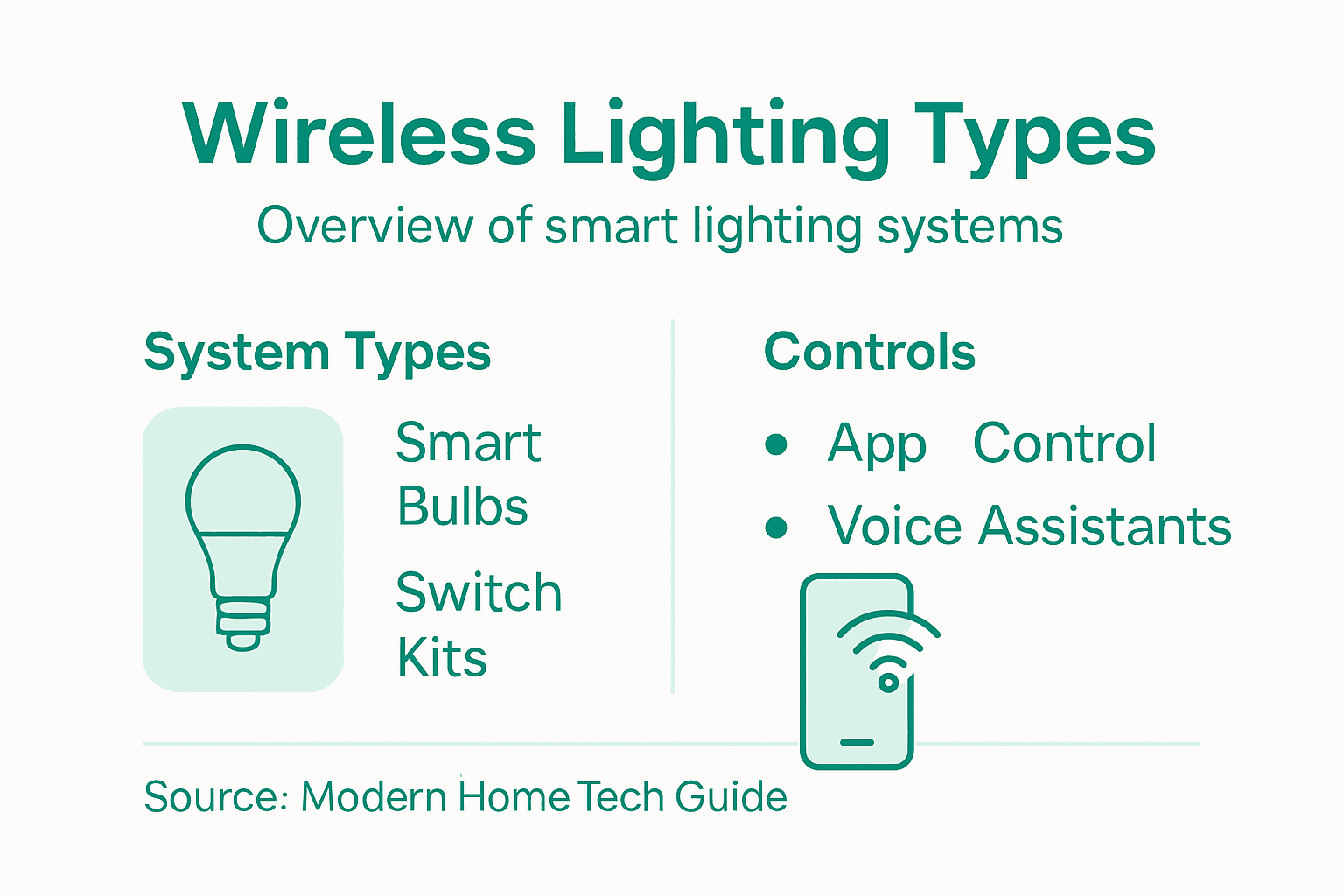
The communication backbone driving these systems relies on wireless protocols that determine range, reliability, and power consumption. Wireless sensor networks and home automation typically operate using Wi-Fi for direct smartphone control, Bluetooth for close-range communication with minimal power drain, and Zigbee for mesh networks that extend coverage across larger homes by having devices relay signals to each other. Each protocol has tradeoffs. Wi-Fi offers convenience and familiar smartphone integration but consumes more battery power. Bluetooth provides energy efficiency perfect for battery-powered fixtures but has limited range. Zigbee excels at creating whole-home networks where devices communicate through intermediaries, making it ideal for multi-room installations where you want consistent coverage without dead zones.
Most modern wireless systems combine multiple components working together. Your controller might be a smartphone app, a wall-mounted wireless remote, or a smart home hub that ties everything together. The lighting fixtures themselves increasingly incorporate advanced sensing capabilities like light-dependent resistors that detect ambient brightness or current sensors that monitor power usage for fault detection. This data flows back to your system, enabling automated responses. For instance, a motion sensor paired with a daylight sensor can prevent lights from turning on during sunny afternoons while still providing automatic illumination during evening hours. The beauty of this approach is flexibility. You can start with one or two fixtures and gradually expand your system without rewiring anything.
Pro tip: Start with a single wireless fixture in a high-traffic area like a hallway or closet to test the protocol and range in your home before committing to a whole-system upgrade.
At its core, wireless lighting operates through a simple but elegant system: radio signals replace electrical wires. When you press a button on your remote or tap your smartphone, that action triggers a radio transmission sent through the air to your light fixtures. The fixtures receive this signal and respond by turning on, dimming, or changing color. The key advantage is that this happens instantly without any physical connection between the control device and the lights themselves. Think of it like a TV remote controlling your television, except the signals are managing your entire home’s lighting ecosystem.

The backbone of wireless lighting relies on specific communication protocols that determine how devices talk to each other. Communication protocols like Bluetooth Low Energy, Zigbee, and Wi-Fi each use different radio frequencies and transmission methods optimized for particular scenarios. Wi-Fi operates on the 2.4 GHz frequency and integrates with your existing home network, allowing smartphone control from anywhere. Bluetooth uses the same frequency but requires pairing devices directly, making it ideal for standalone fixtures with minimal power consumption. Zigbee creates a mesh network where each device acts as a relay point, extending signal coverage throughout larger homes without requiring additional routers or hubs. This mesh approach is why a Zigbee system can cover a sprawling house while individual Bluetooth fixtures might struggle with range.
Here’s a quick comparison of major wireless lighting protocols and their ideal applications:
| Protocol | Typical Use Case | Strengths | Limitations |
|---|---|---|---|
| Wi-Fi | Smartphone control, app integration | Broad compatibility, remote access | Higher power consumption, network congestion |
| Bluetooth | Close-range fixtures, small apartments | Low energy use, direct pairing | Limited range, no mesh support in basic version |
| Zigbee | Large homes, multi-room coverage | Mesh networking, reliable communication | Needs Zigbee hub, device compatibility varies |
What makes wireless lighting particularly clever is mesh networking and self-healing capabilities. In a mesh system, if one light fixture receives a signal, it can pass that signal to the next fixture, which passes it to the next, creating a chain of communication. If one device fails or goes offline, the network automatically reroutes signals through alternative paths, ensuring your system keeps working without interruption. Commissioning and managing these systems happens through a central hub or smartphone app where you create routines, set schedules, and group fixtures into rooms or zones. This central control point acts as the brain of your operation, learning your preferences and enabling automation that would be impossible with traditional wired systems.
A more advanced subset of wireless lighting technology involves visible light communication, where LED light sources transmit data through imperceptible modulation of the light itself. This technique allows LEDs to simultaneously illuminate your space while transmitting information, creating dual functionality from a single fixture. While still emerging in residential applications, visible light communication represents the future of lighting technology, combining illumination with high-speed wireless communication in ways that radio-only systems cannot achieve.
Pro tip: Choose a protocol based on your home’s size and existing smart home ecosystem—Bluetooth for small apartments with few fixtures, Wi-Fi for seamless smartphone integration, and Zigbee for larger homes requiring extended range and reliability.
Wireless lighting delivers three transformative benefits that directly improve your daily life and household finances. Start with convenience, which is perhaps the most immediately noticeable advantage. No more fumbling for light switches in the dark or struggling to reach wall controls when your hands are full carrying groceries or a sleeping child. With wireless systems, you control your entire home’s lighting from your smartphone, voice commands, or wall-mounted remotes. Set up automated routines so lights turn on gradually as you wake, adjust to warm tones in the evening to support better sleep, and turn off automatically when you leave rooms. For busy professionals juggling work, family, and personal time, this level of automation reclaims hours each month that would otherwise be spent managing basic household functions.
Safety improvements are equally compelling. Smart lighting systems with occupancy and ambient light sensors create adaptive lighting that responds to actual need rather than fixed schedules. Motion sensor lights in hallways and staircases illuminate automatically when movement is detected, eliminating the dangerous moments when you navigate dark spaces. Daylight sensors prevent unnecessary lighting during sunny hours while ensuring adequate illumination during evening and night. This adaptive approach is particularly valuable for aging family members who benefit from well-lit pathways, or for parents protecting young children from falls and accidents. The system learns your patterns and anticipates your movements, creating safer living environments without requiring you to think about it.
Energy efficiency represents the financial cornerstone of wireless lighting adoption. Traditional fixed-schedule lighting wastes enormous amounts of electricity by running lights in empty rooms or during daylight hours. Wireless systems eliminate this waste through dynamic illumination adjustment based on occupancy and time of day. A bedroom light that would typically run for eight hours on a timer instead operates for exactly the time someone is present. Office spaces reduce energy consumption by automatically dimming lights when natural sunlight is sufficient. Combined with LED technology that consumes a fraction of the power of incandescent bulbs, these systems achieve dramatic energy savings. Many homeowners report reducing their lighting energy costs by 40 to 60 percent after upgrading to wireless smart lighting, savings that compound year after year and eventually offset the initial investment.
The table below summarizes key benefits of wireless lighting for different user priorities:
| Benefit Area | How Wireless Lighting Delivers Value | Example Impact |
|---|---|---|
| Convenience | Enables remote and automated control | Hands-free lighting routines |
| Safety | Uses sensors for adaptive illumination | Prevents accidents in dark spaces |
| Energy Savings | Reduces consumption with dynamic adjustment | Cuts lighting bills by up to 60% |
Pro tip: Start tracking your current lighting habits by noting which rooms stay lit unnecessarily, then automate those areas first to see immediate energy savings before expanding to other spaces.
The initial sticker price of wireless lighting components often appears higher than traditional wired alternatives. A single wireless smart bulb might cost $20 to $40, compared to a standard bulb at $2 to $5. However, this comparison ignores the hidden costs embedded in wired system installation. Wireless lighting control significantly reduces labor and installation costs by eliminating expensive cabling, conduit runs, and the structural damage that comes with retrofitting older homes. Installing wired lighting in an existing house means hiring licensed electricians to cut into walls, run cables through studs, patch drywall, and restore finishes. These labor costs quickly consume $1,500 to $5,000 or more in a typical home retrofit. Wireless systems bypass this entirely. You unbox fixtures, mount them, and they work within minutes. The total cost of ownership favors wireless in most retrofit scenarios, even when component prices are higher.
Installation differences between wired and wireless systems are dramatic. Wired systems require planning before construction begins and professional installation throughout the process. Any design changes after walls are closed means cutting into finished surfaces. Wireless systems offer complete flexibility. Need to relocate a light fixture? Unscrew it and move it. Want to add motion sensors to a hallway retrofit? Install them without rewiring anything. This adaptability is invaluable for busy professionals managing household upgrades around work schedules. You can install wireless fixtures incrementally, starting with high-traffic areas and expanding gradually as your budget allows. With wired systems, you commit to the entire design upfront or face expensive modification costs later.
Understanding when each approach makes sense helps you make an informed decision. Wired systems excel in scenarios where reliability and interference immunity are critical. New construction projects that plan lighting from the ground up often choose wired solutions because installation costs are negligible compared to overall construction expenses. Mission-critical applications like hospitals or data centers require the absolute stability that hardwired systems provide. However, wireless systems offer superior flexibility, faster installation, and reduced labor costs, making them ideal for retrofits and homes with changing layouts. Wireless also eliminates electromagnetic interference concerns in most residential settings and provides future-proof scalability as your smart home ecosystem grows.
For modern homeowners, wireless lighting represents the pragmatic choice. The component cost premium pays for itself through eliminated installation expenses, and the flexibility means you can upgrade your home lighting without disrupting daily life or calling electricians repeatedly. You maintain control over your investment timeline and can adapt the system as your needs evolve.
Pro tip: Calculate your total installation cost by adding component prices plus estimated electrician labor at $75 to $150 per hour, then compare that against wireless component costs to see the real savings in your specific situation.
The article highlights key challenges that many homeowners face when considering lighting upgrades: complex wiring, costly installation, and the need for flexibility without sacrificing reliability. If you want to eliminate the hassle of electricians and messy renovations while enjoying smart control and energy savings, wireless lighting is the answer. With features like occupancy detection, daylight sensors, and effortless smartphone integration, modern wireless systems deliver convenience, safety, and efficiency exactly where you need it most.
Discover how you can transform your living spaces with wireless solutions that are designed for easy DIY installation and adaptable smart automation. Start with high-traffic areas using our Smart Motion Sensor Lights Collection and experience instant convenience and energy savings without the wait.
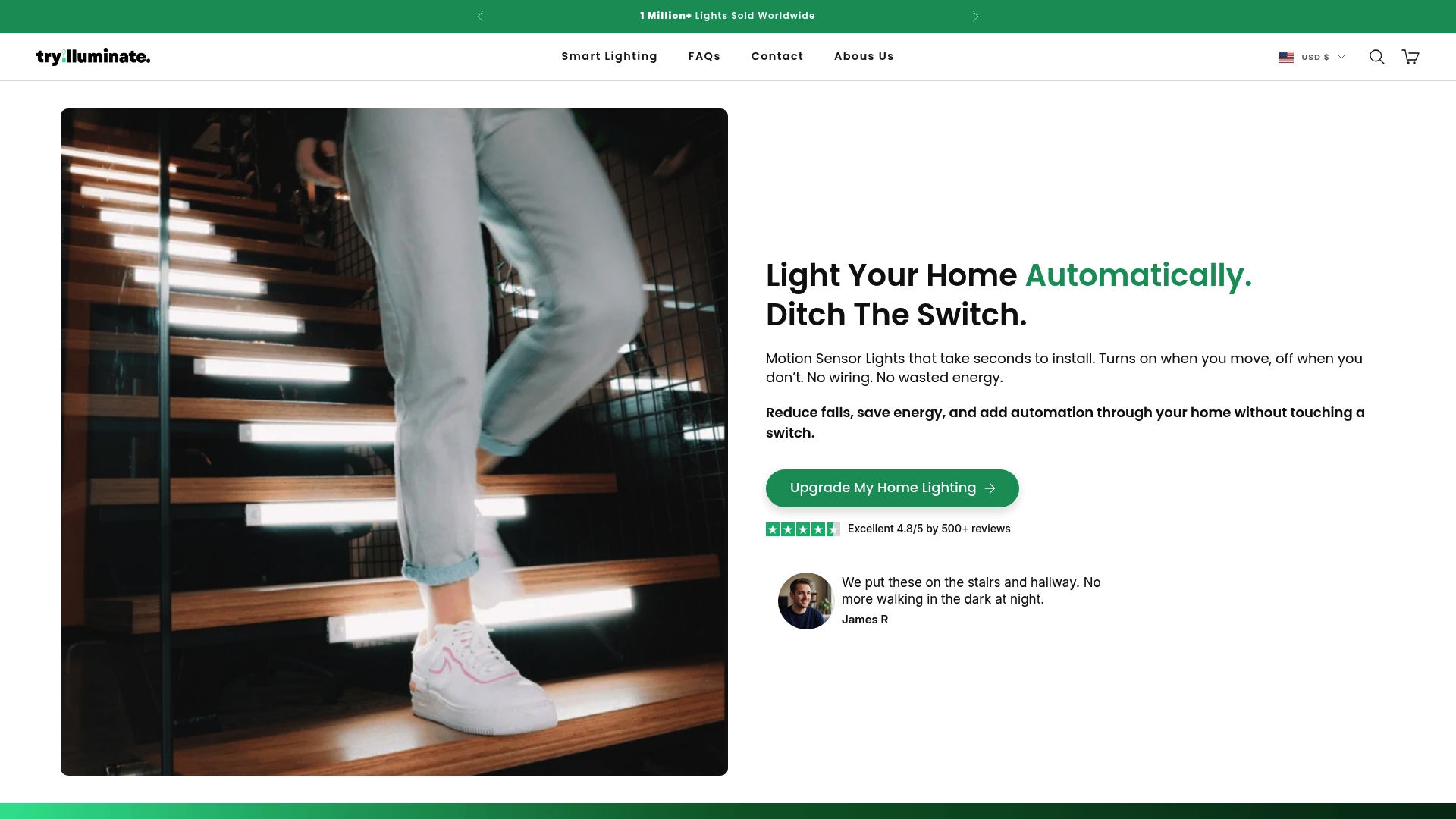
Take control of your home lighting today by exploring our Best Sellers and see why thousands of homeowners trust Try Illuminate for their wireless lighting upgrades. Act now to simplify installation, improve safety, and reduce energy bills with smart lights built for modern living.
Wireless lighting refers to lighting systems that operate through radio signals rather than traditional electrical wiring, allowing for flexible control of light fixtures without the need for extensive installation work.
Wireless lighting offers significant advantages such as easier installation without the need for electricians, flexibility in adding or relocating fixtures, and potential energy savings due to automated lighting control based on occupancy and natural light.
Wireless lighting technology operates by transmitting radio signals from a control device, such as a smartphone or remote, to light fixtures that respond accordingly. Protocols like Wi-Fi, Bluetooth, and Zigbee facilitate this communication, each with unique strengths.
Yes, most modern wireless lighting systems are designed to integrate with smartphone apps, allowing you to control the lights remotely, adjust brightness and color, and automate lighting schedules easily.

Role of Lighting in Home Automation: Energy, Safety, and Ambiance
Learn how modern lighting drives home automation, boosts energy efficiency, enhances safety, and transforms ambiance with wireless smart tech solutions.
Read more
7 Essential Types of Smart Lighting for Safer Homes
Discover 7 essential types of smart lighting for safer homes. Learn how each type can boost safety, save energy, and make installation easy for any homeowner.
Read more